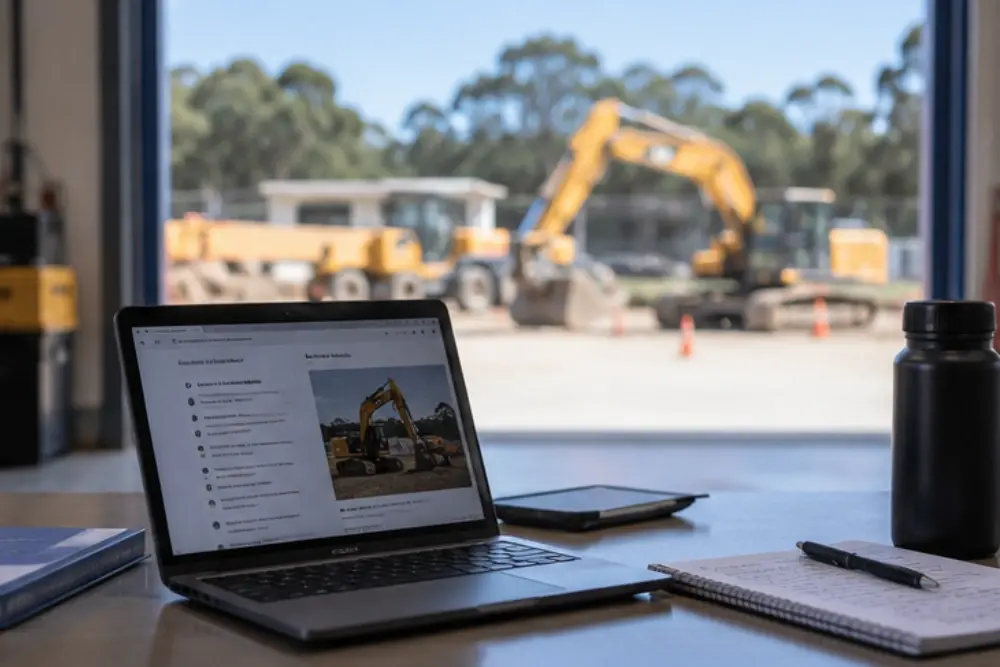
Online construction courses can make the theory side of training much easier to fit around work and other commitments. But in-person training gives you direct access to trainers, equipment and practical assessment. For many construction courses, the most useful option is somewhere between the two.
The right delivery method depends on what you’re learning. A course centred on knowledge and theory may allow substantial online study. Training involving cranes, plant, lifting operations or other practical skills will usually require time with the equipment and an assessor.
There are also courses where the delivery method is set by regulation. In Victoria, White Card training must be completed face-to-face, so an online course isn’t an option.
Understanding those differences before you enrol can save you from choosing a course that doesn’t fit your schedule or, more importantly, the outcome you need.
Where online construction courses work well
The biggest advantage of online learning is flexibility.
If part of a course involves reading, knowledge development or pre-learning, completing that work remotely can reduce the amount of time you need to spend in a classroom. You may be able to work through material at home rather than travelling to a training facility simply to complete theory.
This can be useful if you’re already working in construction and trying to fit training around shifts or site commitments.
Online content also lets you revisit material. Instead of relying entirely on notes taken during a classroom session, you may be able to go back through learning resources before an assessment or when something needs another look.
CTI uses an online portal for learning materials and includes online content in a number of its construction courses. Suitable theory can be completed remotely, while practical training and assessment are completed in person where required.
So, online construction courses don’t necessarily mean completing an entire qualification without attending a training facility.
The limitations of construction courses online
Construction is a practical industry, and some skills can’t be properly demonstrated by answering questions on a screen.
Operating plant, attaching and moving loads, carrying out rigging work or demonstrating safe crane operation requires physical equipment and an environment where an assessor can observe what you’re doing.
ASQA requires Registered Training Organisations to consider the practical requirements of each training product, including whether students need access to physical materials, equipment or a workplace setting. That can limit how much of a construction course can be completed online.
Which means you should look closely at what a provider means when it advertises construction courses online. Is the whole course online? Is only the theory component online? Do you need to attend practical training later? Where does assessment take place?
Those details make a much bigger difference than the word online in the course description.
What you gain from in-person construction training
For practical skills, face-to-face training gives you something an online platform can’t: direct experience with the task you’re learning.
You can work with equipment, practise procedures and receive feedback from a trainer while you’re doing them. If your technique is wrong or you’ve misunderstood a step, the trainer can address it there rather than waiting until a final assessment.
It can also make technical material easier to understand. A diagram explaining load movement is useful, for example, but seeing the equipment and applying the principle gives the theory a physical context.
CTI’s training facility at Riddells Creek includes equipment used for practical construction training, with courses covering areas such as dogging, rigging, cranes, scaffolding, earthmoving and elevating work platforms.
For students comparing construction courses in Melbourne, access to the right training equipment should be part of your decision alongside price, location and course duration.
The trade-offs with face-to-face courses
In-person training does require more planning.
You’ll need to travel to the training location and be available at the scheduled time. If you’re working full time, that can mean arranging time away from work rather than fitting study into evenings or quieter periods.
Location also becomes more important. A suitable course 10 minutes from home and one that requires an hour’s drive may provide the same formal outcome but fit very differently into your week.
That doesn’t automatically make online training the better choice. If the course requires practical attendance anyway, an apparently convenient online option may only shift when you travel rather than remove the need altogether.
Check the full course structure before comparing convenience.
Blended training can offer a useful middle ground
A blended course separates the parts that can sensibly be completed remotely from those that need direct training or assessment.
For construction training, this can be a practical arrangement. Theory and some knowledge checks can be handled online, while equipment-based learning and practical assessment happen face-to-face.
CTI’s Tower Crane course is one example. The current course structure includes an online multiple-choice component, while the practical demonstration and other assessment requirements take place in person.
The same principle applies more broadly. If you’re comparing online courses in civil construction, check how much of the program can be completed remotely and where the practical training and assessment take place.
A course described as blended also isn’t automatically more flexible. Check which components are online, what must be completed before attending and whether there are fixed deadlines for the remote work.
Some construction courses must be completed in person
Delivery format isn’t always up to the provider or student.
General construction induction training, commonly known as the White Card, must be completed face-to-face in Victoria. WorkSafe Victoria does not recognise online White Card training for Victorian construction induction requirements.
CTI delivers its White Card course face-to-face at Riddells Creek.
This is why it’s risky to assume that all online building and construction courses work the same way. The permitted delivery method depends on the particular training product and, in some cases, regulator requirements.
How to choose the right delivery method
Start with the course outcome rather than deciding that you want online or classroom training first.
Check the exact course or Unit of Competency, then find out how the provider delivers it. For nationally recognised training, confirm that you’re dealing with a Registered Training Organisation and check exactly which portions of the training and assessment are online.
It also helps to ask:
- How much attendance is required?
- Where will practical training and assessment take place?
- What equipment will you train on?
- Is there online pre-learning before the first training day?
- How can you contact a trainer if you need help with remote study?
- Are there prerequisites you need to complete before starting?
You can compare CTI’s current construction courses to see the different training areas available. Some also allow offsite delivery where the workplace, equipment and other requirements are suitable.
For practical construction work, the choice often isn’t simply online versus in-person. It’s about using each format for the part of the training it suits.
Construction Training International combines online learning content with practical training across a range of courses and operates from its Riddells Creek training facility north of Melbourne. If you’re unsure how much of a particular course can be completed online, check the individual course requirements before booking or contact us to learn more about the delivery options available.