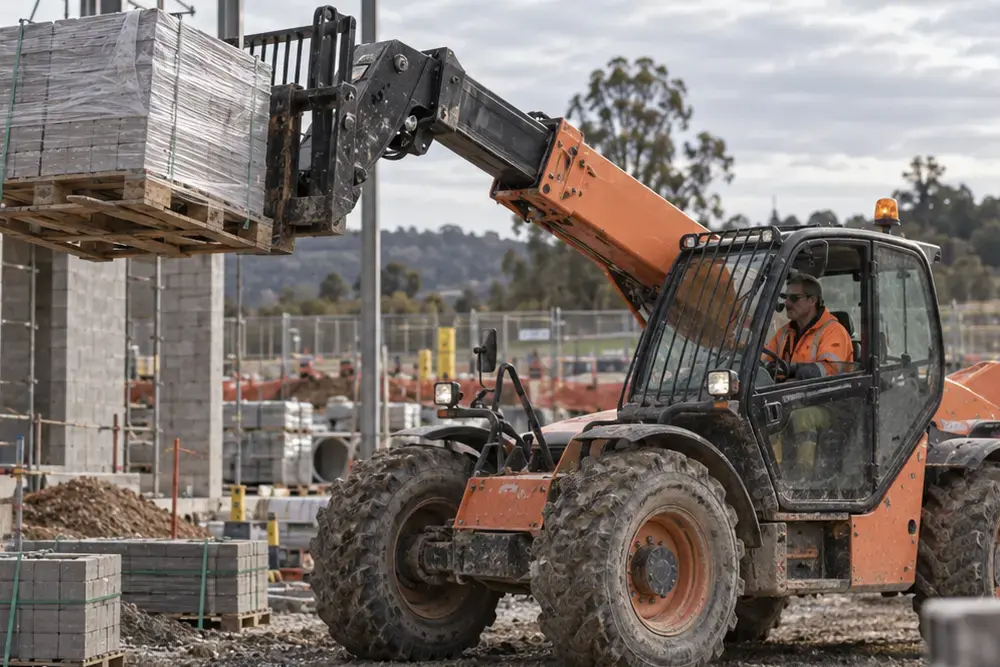
Telehandler operators work across construction, civil infrastructure, mining, agriculture and materials-handling jobs, with current vacancies ranging from Melbourne building sites to remote resource projects.
The catch is that telehandler licence can mean different things depending on the machine and where you’re working. In Victoria, a TV High Risk Work licence covers non-slewing telehandlers with a rated capacity over 3 tonnes. Slewing telehandlers and some work-platform setups need different licence classes.
So before chasing telehandler jobs, it helps to know what your current training allows you to operate.
Construction sites are one of the main options
Construction is probably the most obvious place to find telehandler operator jobs.
Telehandlers are useful on sites where materials need to be unloaded, carried across rough ground or placed somewhere a conventional forklift would struggle to reach. Here you might find yourself working on residential developments, commercial builds and demolition projects.
Typical work can include:
- unloading pallets and deliveries
- moving bricks, blocks and other materials around the site
- placing loads at upper levels
- supplying materials to trades
- moving equipment across uneven ground
- helping manage day-to-day site logistics
Some jobs combine telehandler operation with labouring or another plant role rather than employing someone solely as an operator.
So, extra tickets become useful. A White Card will commonly be required for construction work, while employers may also favour operators who can use other plant or hold dogging, rigging, forklift or EWP qualifications.
Civil construction and infrastructure projects
Telehandlers also turn up regularly on civil and infrastructure work.
That can include road, rail, utilities, transmission and renewable-energy projects where materials need to be moved over larger sites or placed around active works.
One recent Australian infrastructure role, for example, involved telehandler operators working across access tracks, bulk earthworks and transmission construction. The duties included moving equipment and materials, loading and unloading and working alongside dogmen, riggers and other site crews.
Large projects can involve more specialised machines
Infrastructure projects may use standard non-slewing telehandlers or larger rotating models.
It’s a distinction that affects your licence.
A Victorian TV licence only covers non-slewing telehandlers over 3 tonnes. If the machine slews, WorkSafe Victoria requires an appropriate slewing mobile crane High Risk Work licence based on the telehandler’s rated capacity.
The relevant classes are:
| Telehandler type | Victorian licence requirement |
| Non-slewing, 3 tonnes or less | No specific High Risk Work licence, although training and competency are still required |
| Non-slewing, over 3 tonnes | TV or an eligible mobile crane High Risk Work licence |
| Slewing telehandler | C2, C6, C1 or C0, depending on rated capacity |
| Work platform with boom of 11 metres or more | WP as well as any licence required for the telehandler itself |
This becomes important if you’re looking at 360-degree or rotating telehandler work. Many infrastructure advertisements ask specifically for slewing crane qualifications as well as telehandler competency.
Mining, shutdowns and FIFO telehandler jobs
A telehandler ticket can also lead into mining and resources work.
The work can be quite different from a suburban building site. You may be moving plant components, supplies or materials over a large work area and working longer shifts as part of a roster.
FIFO telehandler jobs can also ask for a broader set of competencies, such as:
- previous mine or civil experience
- additional plant tickets
- dogging or rigging
- working at heights
- EWP training
- a current driver licence
The telehandler ticket might get you through one part of the requirements, but employers commonly look at the overall mix of site experience and licences.
Warehouses, yards and materials handling
WorkSafe Victoria lists warehousing as another industry where telehandlers are used.
You’re more likely to see them where loads need to be shifted outside a conventional warehouse environment, particularly in larger yards or sites with rough or uneven surfaces.
The extended boom also makes a telehandler useful where materials need to be placed beyond the reach of a normal forklift.
But a telehandler should not automatically be treated as a forklift.
A standard forklift licence does not replace the relevant telehandler High Risk Work licence when one is required. Equally, holding a Victorian TV licence does not give you a general forklift licence.
If a job advertisement uses terms such as telehandler forklift operator, check the actual machine and licence requirements rather than relying on the job title.
Agriculture and rural work
Telehandlers are also widely used in agriculture.
Common attachments allow them to move pallets, bulk materials and other farm loads, while their reach and rough-terrain ability suit larger properties and agricultural yards.
The same Victorian licensing rules still apply. A non-slewing machine rated over 3 tonnes requires the appropriate High Risk Work licence, while a smaller machine still needs a competent operator who has received suitable information, instruction and training.
This is one area where it is especially important not to assume that years of tractor or loader experience automatically cover telehandler operation.
Your licence does not automatically travel with every job
If you hold Victoria’s TV licence, there is one major limit to keep in mind: the licence class is specific to Victoria.
The TV licence is only applicable in Victoria. If you want to take telehandler jobs in Sydney, Brisbane, Perth or elsewhere interstate, you need to check the requirements in the state or territory where the work will take place.
It is a detail you need to be especially aware of if you’re looking at FIFO telehandler jobs or following infrastructure projects around Australia.
Job advertisements can use fairly loose language such as telehandler ticket, telehandler licence or even Gold Card, but those terms do not necessarily describe the same regulatory outcome.
Check:
- which state the work is in
- whether the machine slews
- the machine’s rated capacity
- which attachments will be used
- the exact licence or competency the employer requires
This makes for a better starting point than assuming one course covers every telehandler job in Australia.
Choosing the right telehandler course in Victoria
Construction Training International offers two telehandler-related pathways, and they serve different purposes.
TV licence for non-slewing telehandlers over 3 tonnes
CTI’s 11249NAT – Licence to operate a Non Slewing Telehandler (TV) is the relevant pathway if you need the Victorian TV High Risk Work licence.
It covers non-slewing telehandlers with a rated capacity greater than 3 tonnes and runs for three days, including the High Risk Work licence assessment.
Successfully completing the training does not itself issue the licence. After passing the assessment, you still need to apply through WorkSafe Victoria.
RIIHAN309F for telescopic materials handler operations
CTI also offers RIIHAN309F – Conduct Telescopic Materials Handler Operations.
This 2-day Unit of Competency covers telescopic materials handler operation and can also form part of RII30920 Certificate III in Civil Construction – General.
It is not the same outcome as the Victorian TV High Risk Work licence.
Which course makes sense depends on the machine you expect to operate and what the employer or site requires.
Look at the jobs you want before choosing the ticket
The range of telehandler jobs in Australia is fairly broad. Jobs can cover residential and commercial construction, civil infrastructure, mining, shutdowns and remote project work, while WorkSafe also identifies agriculture and warehousing as common telehandler industries.
The better question is not only where you can work with a telehandler licence, but what machines those employers use.
If most of the jobs you’re interested in involve non-slewing telehandlers over 3 tonnes in Victoria, the TV licence is the obvious course to investigate. If the work involves rotating telehandlers, work platforms or interstate projects, you may need a different or additional licence.
Enquire with CTI and tell the team what machine and type of work you’re aiming for. They can help you work out which training pathway fits.